If you're behind on payments and the letters keep piling up, you've probably come across the term IVA somewhere online. It sounds official, a bit scary, and confusing all at once. This guide breaks it down in plain terms, so you know exactly what an IVA is, how it works, and whether it might be the right move for your situation.
Key takeaways:
- An IVA is a formal, legally binding agreement between you and your creditors to repay debts over a set period, usually five to six years.
- It's arranged through a licensed insolvency practitioner (IP), not directly with lenders.
- Once creditors holding 75% or more of your debt (by value) agree, the arrangement becomes binding on all included creditors.
- Interest and charges are usually frozen, and any remaining debt is written off once the IVA completes.
- An IVA affects your credit file for six years and isn't suitable for everyone, so it's worth comparing it against other options first.
What Does IVA Actually Mean?
An Individual Voluntary Arrangement, or IVA, is a formal agreement between someone who owes money and the people they owe it to. It's set up under UK insolvency law and is legally binding once approved. Unlike an informal debt management plan, an IVA has legal weight behind it, which is why creditors take it seriously and why it can offer real protection to the person in debt.
According to Wikipedia's explanation of individual voluntary arrangements, the arrangement is a formal alternative to bankruptcy in England, Wales, and Northern Ireland, allowing a debtor to pay back a portion of what they owe over a fixed period while the rest is written off at the end.
In simple terms, instead of juggling five or six creditors chasing you separately, you make one affordable monthly payment. That payment gets split between your creditors by a licensed insolvency practitioner who manages the whole process on your behalf.
Who Can Actually Apply for an IVA?
Not everyone qualifies. Lenders and insolvency practitioners look at a few things before agreeing to set one up:
- You owe money to more than one creditor. IVAs are built for people juggling multiple debts, not a single loan.
- You have a regular income. You need enough disposable income each month to make consistent payments.
- Your total debt is usually above a certain threshold. Most IPs won't recommend an IVA for very small debts, since a debt management plan or other route might work out cheaper.
- You're based in England, Wales, or Northern Ireland. Scotland has a similar but separate system called a Trust Deed.
If you're not sure where you stand, it helps to speak to someone who deals with this daily. At Debt Free Path, we've spent over eight years helping people across the UK work out whether an IVA, a debt management plan, or another route fits their circumstances best, rather than pushing one solution on everyone.
How an IVA Works, Step by Step
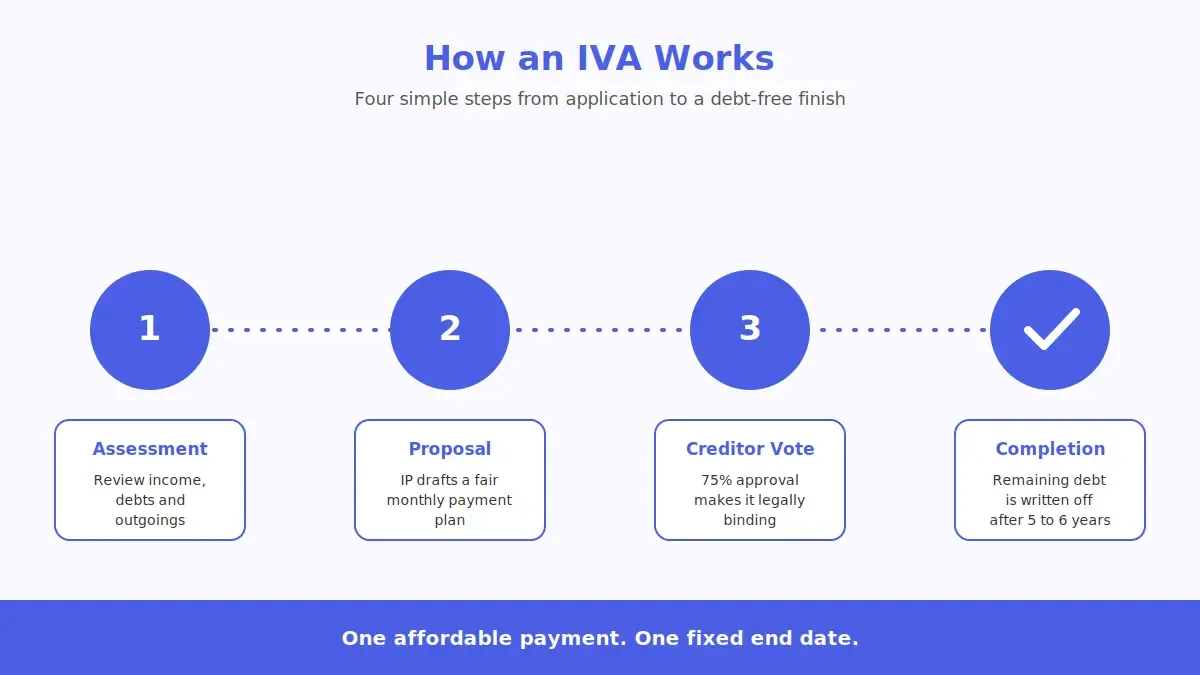
The process follows a fairly predictable path from start to finish. Here's the general life cycle:
- Initial assessment. You speak to a licensed insolvency practitioner or an adviser who reviews your income, debts, and outgoings to see if an IVA suits your situation.
- Proposal drafted. The IP puts together a formal proposal, including how much you can afford to pay each month and for how long.
- Creditors vote. Your creditors review the proposal at a creditors' meeting. If creditors representing at least 75% of your total debt (by value) agree, the IVA is approved.
- Arrangement becomes binding. Once approved, all creditors included in the IVA must stick to it, even the ones who voted against it or didn't respond.
- Monthly payments begin. You pay one affordable amount each month to the IP, who distributes it among your creditors.
- Completion. After the agreed term, usually five to six years, any remaining balance on the included debts is written off and you're debt free from those obligations.
Throughout this period, interest and charges on the included debts are typically frozen, and creditors can't take further legal action against you for those debts. This is one of the main reasons people consider an IVA over simply trying to manage debts informally.
IVA vs Other Debt Solutions
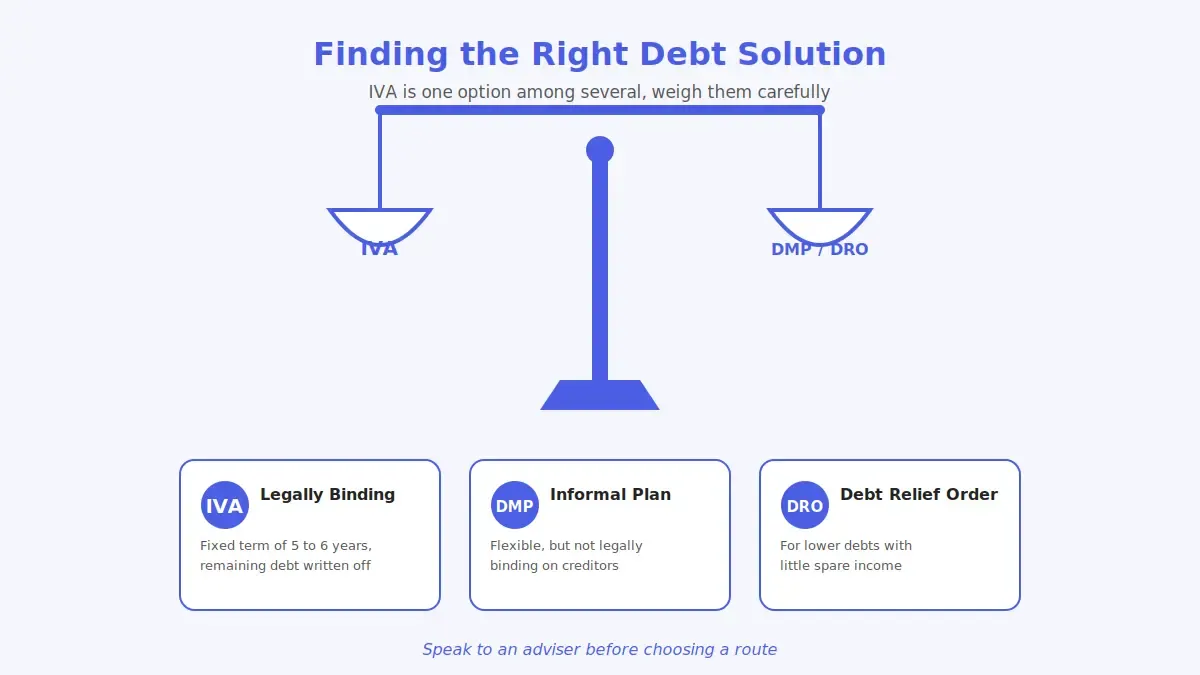
An IVA isn't the only route out of debt, and it's not automatically the best one for everyone. Here's a quick comparison to put things in perspective:
| Solution | Legally Binding? | Typical Duration | Debt Written Off? |
|---|---|---|---|
| IVA | Yes | 5 to 6 years | Yes, remaining balance at the end |
| Debt Management Plan | No | Varies, until debt is repaid | No, full amount is still owed |
| Bankruptcy | Yes | Usually 12 months | Yes, most unsecured debt |
| Debt Relief Order | Yes | 12 months | Yes, if conditions still met after 12 months |
The official gov.uk page on individual voluntary arrangements outlines the formal eligibility rules and what happens if you miss a payment, which is worth a read if you want the legal detail straight from the source.
The Pros and Cons of an IVA
Like any debt solution, an IVA has real benefits but also trade-offs worth weighing carefully before you commit.
| Advantages | Disadvantages |
|---|---|
| One affordable monthly payment instead of several | Stays on your credit file for six years |
| Interest and charges are usually frozen | You may need to release equity from your home if you're a homeowner |
| Creditors can't take further legal action once it's approved | Missing payments can put the arrangement at risk |
| Remaining unsecured debt is written off at the end | Fees apply, usually taken from your monthly payments |
What Happens If You Miss a Payment?
Missing one payment usually won't break the arrangement straight away. Most IPs allow a small buffer or will discuss the missed payment with you directly. But if payments are missed repeatedly without communication, the IVA can fail. If that happens, creditors can go back to chasing the full original debt, and in some cases push for bankruptcy instead.
This is why it's worth being realistic about affordability before signing up. According to Investopedia's overview of individual voluntary arrangements, the arrangement only works as intended when the debtor can consistently meet the agreed payment schedule over the full term.
How Much Does an IVA Cost?
You don't pay upfront fees out of pocket in most cases. Instead, the insolvency practitioner's fees are built into your monthly payment and taken from the amount collected before it's distributed to creditors. Fees generally cover two parts: a nominee fee for setting up the arrangement, and a supervisor fee for managing it until completion.
Because these fees vary between providers, it's worth asking for a clear breakdown before agreeing to anything. A good adviser will explain this upfront rather than burying it in paperwork.
Is an IVA Right for You?
There's no single answer here, since it really depends on your income, the size of your debt, and how many creditors are involved. If you're dealing with debt spread across several credit cards, loans, or overdrafts, and you have a steady income but not enough to clear everything quickly, an IVA might genuinely help. If your debt is small or you don't have consistent income, other routes might make more sense.
We put together a broader breakdown of the options available in our guide on how to get out of debt in the UK, which covers IVAs alongside other solutions if you want to compare before deciding.
Over the past eight years, we've worked with people in all kinds of financial situations at Debt Free Path, and one thing that's consistent is this: the right solution depends entirely on your own numbers, not a generic answer online. What worked for a neighbour or a colleague might not be the best fit for you.
A Quick Example
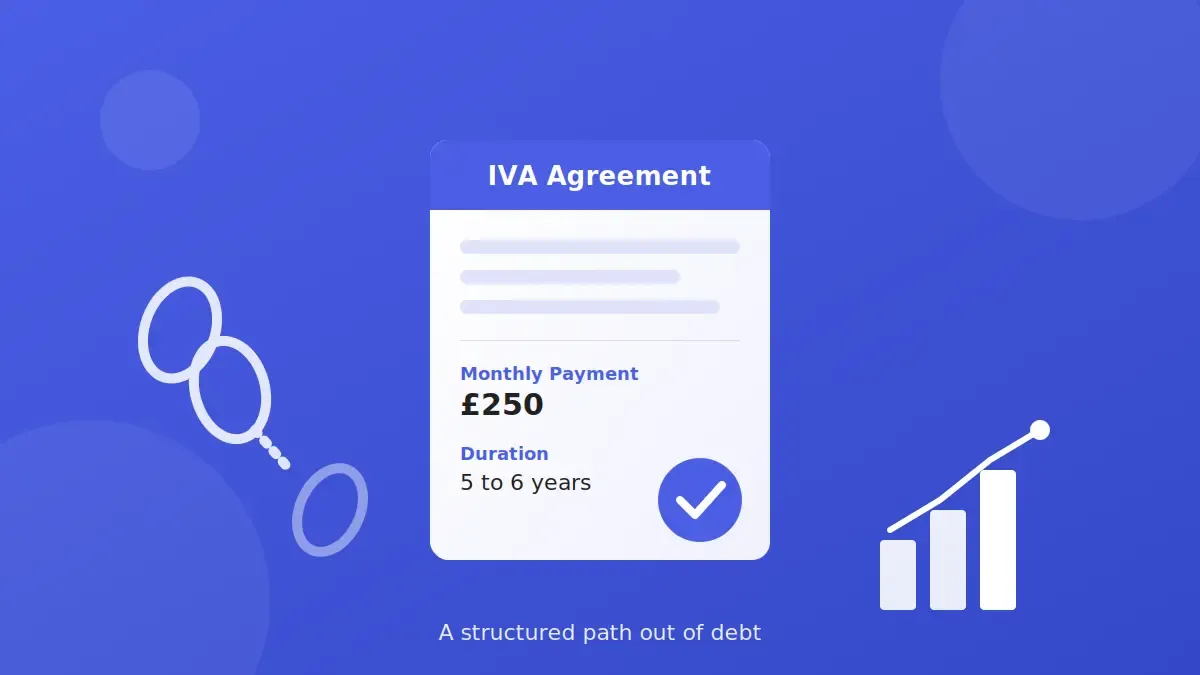
Say someone owes 18,000 pounds spread across three credit cards and a personal loan, and they can afford 250 pounds a month after covering essential bills. An IVA might combine all four debts into one 250 pound monthly payment over six years, totalling 18,000 pounds paid before fees. If their circumstances mean the full amount can't be repaid within the term, whatever remains on those debts gets written off once the arrangement completes. That's the core appeal: a fixed end date and a payment you know you can actually manage.
Final Thoughts
An IVA can offer a genuine way out of overwhelming debt, with the structure and legal backing to keep creditors from adding pressure while you pay it off. But it's a serious commitment that affects your credit file and, in some cases, your assets. Before deciding, it's worth speaking to someone who can look at your full financial picture and walk you through what fits best.
At Debt Free Path, we help people build a realistic, judgement-free plan to become debt free — not overnight, but step by step. If you're ready to talk through your options, contact our team today.
Frequently Asked Questions
Yes. An IVA is recorded on your credit file for six years from the date it starts, even if you finish paying it off sooner. During this time it will likely make it harder to get new credit, mortgages, or favourable interest rates.
In most cases, yes. Your home isn't automatically at risk, but if you're a homeowner, you may be asked to try to release equity from your property in the final year of the arrangement to increase what's repaid to creditors. If that's not possible, your IVA term is usually extended instead.
You can usually keep a basic bank account for everyday spending, though some banks may restrict accounts once an IVA is registered. Credit cards and other forms of new borrowing are generally off-limits while the arrangement is active, since taking on new debt would work against the terms you've agreed to.
Most unsecured debts can be included, such as credit cards, personal loans, overdrafts, and store cards. Secured debts like your mortgage are excluded, and certain obligations such as court fines, child maintenance, and student loans generally can't be written off through an IVA.
You can ask your insolvency practitioner to end the arrangement, but doing so usually means you lose the benefit of having debts written off, and creditors can pursue the outstanding balance again. If your circumstances have genuinely changed, it's worth discussing options with your IP first, since payments can sometimes be adjusted rather than the whole arrangement cancelled.
Not Sure If an IVA Is Right for You?
Talk to our team for honest, judgement-free advice — free and confidential.
Get Free Advice Today